The Annual Bill of Rights Contest Announces Winners

Sponsored by the Federal Bar Association, the Annual Bill of Rights contest urges students to dive deep into the history and meaning of the first Ten Amendments.

This year’s contest challenged students to suggest what amendment they would add to the Constitution. The contest received close to 50 student essays advocating for innovative amendments.

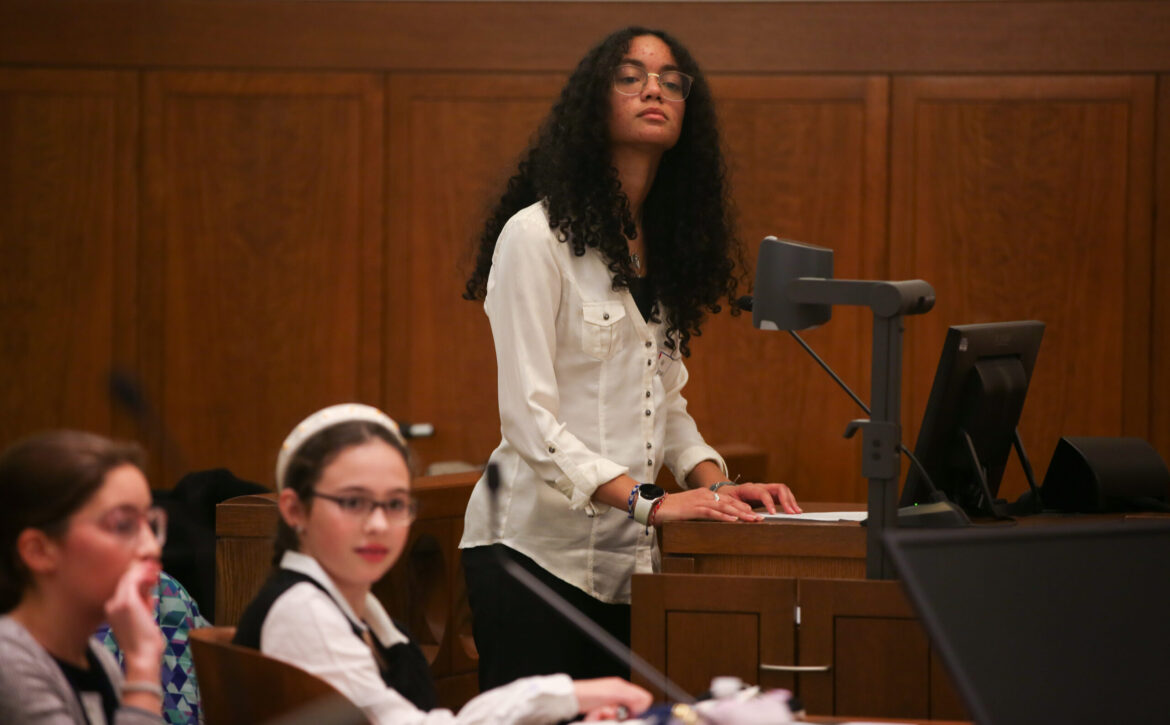
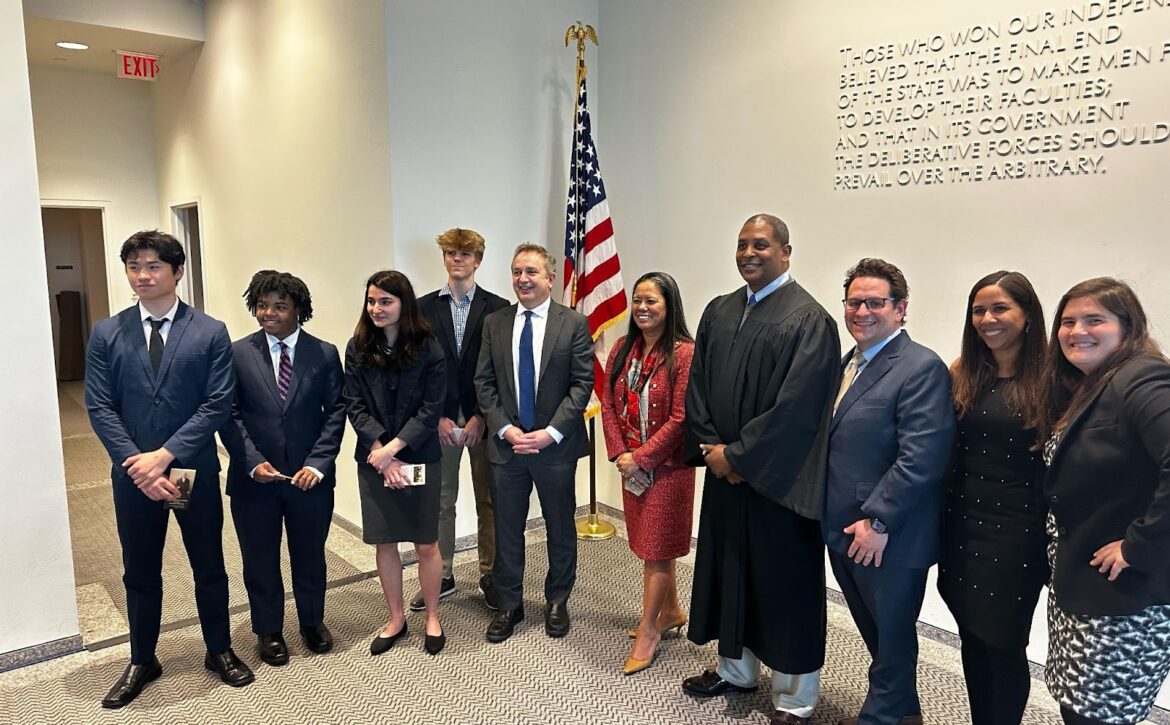
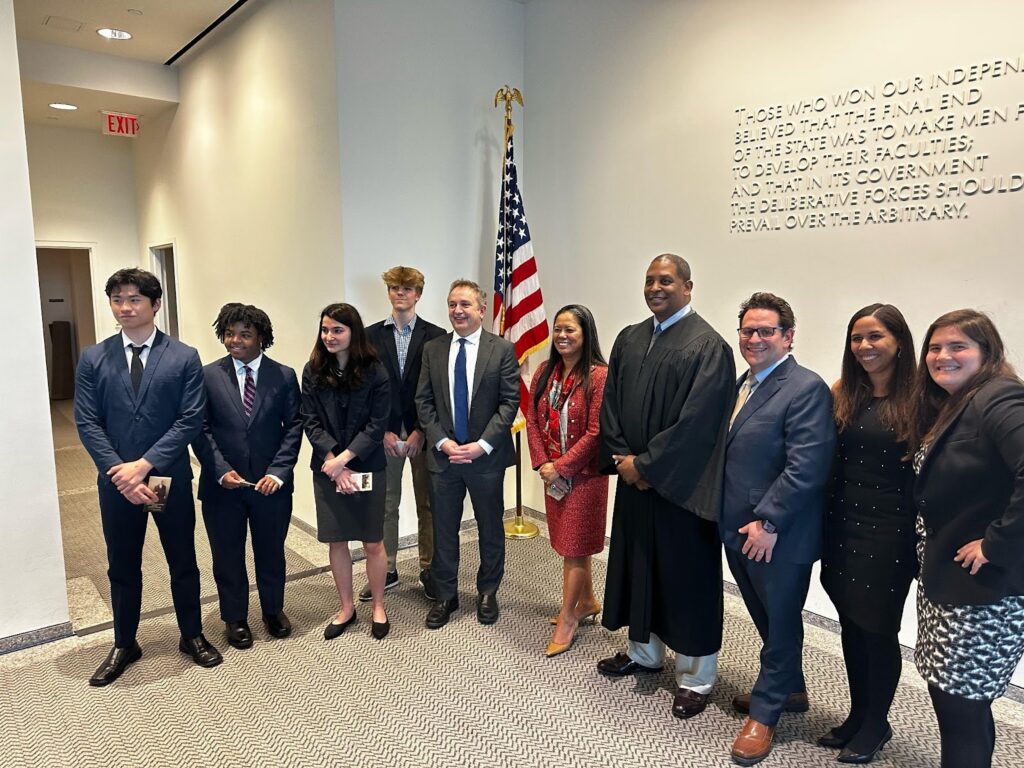
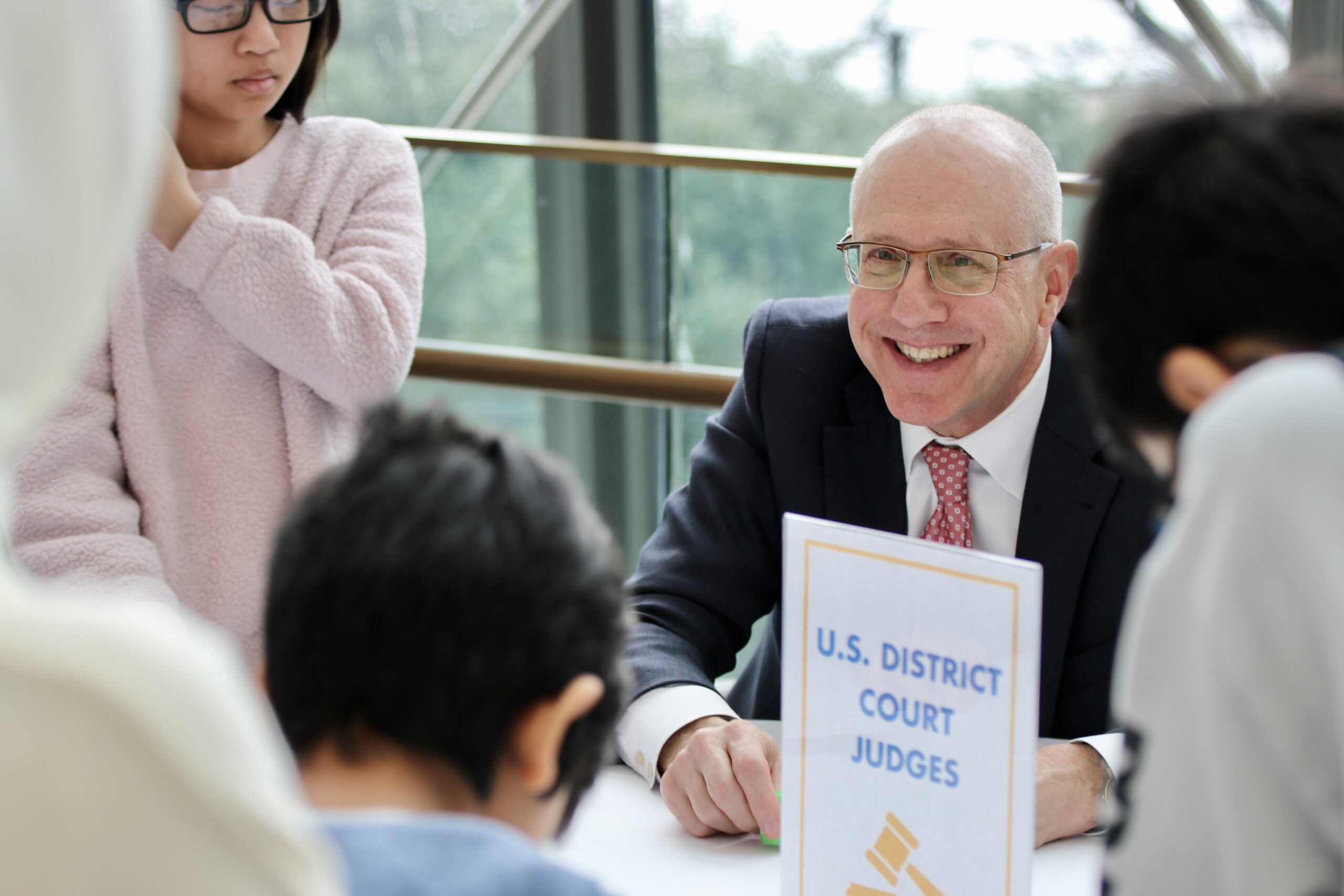
First Circuit Appeal Court Chief Judge David Barron and U.S. District Court judges played major roles in The Annual Bill of Rights Contest celebration, from reading student essays to giving live feedback to the winners. Some of the proposed amendments protected guaranteed housing for all, protection of student privacy, and the right to an education.

The contest was open to students from Boston, Worcester, and Springfield. The first-place prize winner Daphne Athanasopoulos, from Boston Latin High School, was awarded $500, the second-place prize winner Adam Whitney, from Boston Latin High School, received $300, and the third-place prize winner Phat Do, from Boston Latin High School, received $200. There were cash prizes for honorable mentions as well.

2023 Federal Bar Association Bill of Rights Essay Contest Winning Essay by Daphne Athanasopoulos

Is there a right to privacy in the Constitution, despite it never being explicitly stated? Justice Louis Brandeis said that the Constitution protects Americans “in their beliefs, their thoughts, their emotions, and their sensations” and “conferred, as against the government, the right to be let alone – the most comprehensive of rights and the right most valued by civilized men.” He recognized that the concept of privacy existed in our Constitution, even though it was never mentioned. I agree with Louis Brandeis in that there is no freedom without privacy. I would add an explicit amendment to the Bill of Rights protecting this foundational right.

What would a world without privacy be like? I along with thousands of other American ninth graders confront such a world in George Orwell’s dystopian novel 1984. Orwell showed us that a world without privacy is a world without freedom. The citizens are completely controlled because they are constantly being watched and lose all dignity. There is nowhere to hide: “Winston kept his back turned to the telescreen. It was safer, though, as he well knew, even a back can be revealing.” 1984 is a fantasy – or is it prescient? I can’t help but think that the surveillance state’s telescreens watching Winston resemble my Alexa listening to me from the kitchen. In our world, the surveillance states of Russia and China use technology to monitor and repress their populations, while corporations in the U.S. trade our personal data for profit. When it comes to the protection of our digital privacy, we are closer to this hellish reality than we realize.

The right to privacy is implicit in our Constitution. For example, the Fourth Amendment protects “persons, houses, papers, and effects” from unreasonable searches and seizures. However, the papers and effects of today not only include physical objects but the digital information that we are unknowingly making public. How much of our personal information do we really own? Once our information enters the cloud, there is no way to know how many people can now access it. Even the websites we browse monitor our behavior. Our devices are constantly tracking us in what we read, where we go, and what we buy. My fellow classmates, myself included, use “free” social media apps but pay for them with our personal data. Under the European Union Data Protection Law, personal data is not considered a commodity. Our information should be similarly protected and not subject to the algorithm that defines us.

In 1928, Justice Brandeis was concerned about wiretapping, which he compared to “opening a sealed letter.” He saw no difference between the electronic transmission of personal information and physical property. He thereby realized the threat that emerging technology posed on privacy and fundamental liberty. Privacy is imperative for maintaining human dignity and is a necessary condition for individuality. Article 8 of the EU’s Charter on Fundamental Rights protects personal data as a fundamental right. To guarantee our freedom, the U.S. The Constitution must make explicit what is already implicit and protect our liberty by protecting our privacy.

Read More

Law Day Festivities Fill the Moakley Courthouse with Students

Law Day at the Moakley Courthouse celebrated a dynamic program for students from fifth grade to law students. On May 3rd Discovering Justice, the Court of Appeals for the First Circuit, the U.S. District Court for the District of Massachusetts, and the Federal Bar Association partnered to provide engaging and educational opportunities for over 150 students.

Students participated in Mock Jury Selections, the Bill of Rights Essay Contest celebration, and observed First Circuit oral arguments. In addition, Discovering Justice hosted an interactive scavenger hunt for fifth graders.

During the scavenger hunt, students from the Highlands School in Braintree met with various courthouse representatives. Representatives from the U.S. Probation Office, the U.S. Marshals Office, the United States Attorney’s Office, the First Circuit Library, the U.S. District Court for the District of Massachusetts, and the Appeals Court for the First Circuit, were present at the scavenger hunt.

Additionally, Court Reporters, Civil Attorneys, Law Clerks, and the U.S. Federal Defender Kyana Givens met with students to discuss their potential legal careers.

“I am grateful that my fifth-grade students were welcomed into the Moakley Courthouse to learn about our justice system. They were thrilled to explore the Courthouse and meet staff from all different courtroom positions. This experience has impacted my students in a positive way and will motivate them to learn more about civics in future grades.”

– Alicia Quinn, 5th Grade Teacher, Highlands School, Braintree Public Schools

Students rotated through each career booth and met courthouse staff to learn about their jobs. Once they connected with each representative, they received stamps on their Law Day passports.

Read More

Inspiring Stories of Women’s Paths to the Bench

A crowd of more than 300 attendees on Zoom and at the Moakley Courthouse heard U.S. District Court Judge Patti Saris, Judge Nancy Gertner (Ret.), Justice Fernande R. V. Duffly (Ret.), and Judge Angel Kelley, talk about the inequalities, biases, and other barriers that stood in the way of their path to the bench, and how they overcame them.

The event, Her Honor: Stories of Challenge and Triumph from Women Judges held on April 26th, was part of Discovering Justice, the U.S. First Circuit Court of Appeals, and the U.S. District Court of Massachusetts Spring Moakley Courthouse Event series.

The discussion and book signing event on the collection of the same name tells the stories of 25 women judges and their paths and experiences on the bench. Lauren Stiller Rikleen, the book’s editor, also joined the panel and talked about her journey in compiling this set of inspiring stories. The crowd was welcomed by Discovering Justice Board member Abim Thomas, Vice President at Fidelity Investments, and the panel was moderated by Judge Patti Saris.

This event was co-sponsored by the Women’s Bar Association of Massachusetts, the Hampden County Bar Association, Citizens for Juvenile Justice, the Harvard Women’s Law Association, and the Massachusetts Black Lawyers Association.

You can get a copy of Her Honor: Stories of Challenge and Triumph from Women Judges here. Use the code HerHonor23 for a discount.

Read More
Discovering Justice Mock Trials December 13, 2022. (Photo/Reba Saldanha)

Kicking Off Discovering Justice’s 14th Year of Mock Appeal

Last week, 26 middle schools kicked off Discovering Justice’s Spring Mock Appeal Program as students worked with their legal mentors starting in on their legal briefs and learning how the appellate court system works.

The Spring Appeal Program follows Discovering Justice’s Fall Mock Trial Program in which nearly 300 jurors in courthouses across Massachusetts ruled on the Fourth Amendment case Ross v. Clearmont High for 29 student teams. Student attorneys came back this week and rejoined their legal mentors to appeal the jury’s verdict.

“My experience serving as a juror for the Mock Trial program was a big factor in my decision to ask my colleagues to join me in volunteering this semester as legal mentors. The program ran so well, and I was happy to be a part of it,” said Kate Cruickshank, an attorney from Murphy & King, P.C. and one of Discovering Justice’s newest legal mentor volunteers. These dedicated legal mentors will volunteer one afternoon a week through May to work with teams of 10-15 student attorneys to help them explore the Ross v. Clearmont High case and build their arguments.

Erin Sulva, Cruickshank’s colleague, shared her enthusiasm for the program. “I look forward to collaborating on something fun and meaningful with my coworkers, and the opportunity to hear perspectives of kids from the community. It will be cool to have a mostly female team to show the students that there are successful women in law.”

The Mock Appeal Program will culminate the last week of May, with students arguing their case before a panel of three judges in the Moakley Courthouse and courthouses across Massachusetts.

Read More

Students, Teachers, Legislators, and Advocates Call for Increased Investment in Commonwealth’s Civic Education Programs

Highlighting the need for more equitable and robust civic education across the Commonwealth, legislators, teachers, students, and advocacy leaders called on the Massachusetts Legislature to increase investment in civic education to help prepare the next generation to steward the Commonwealth’s and nation’s democracy.

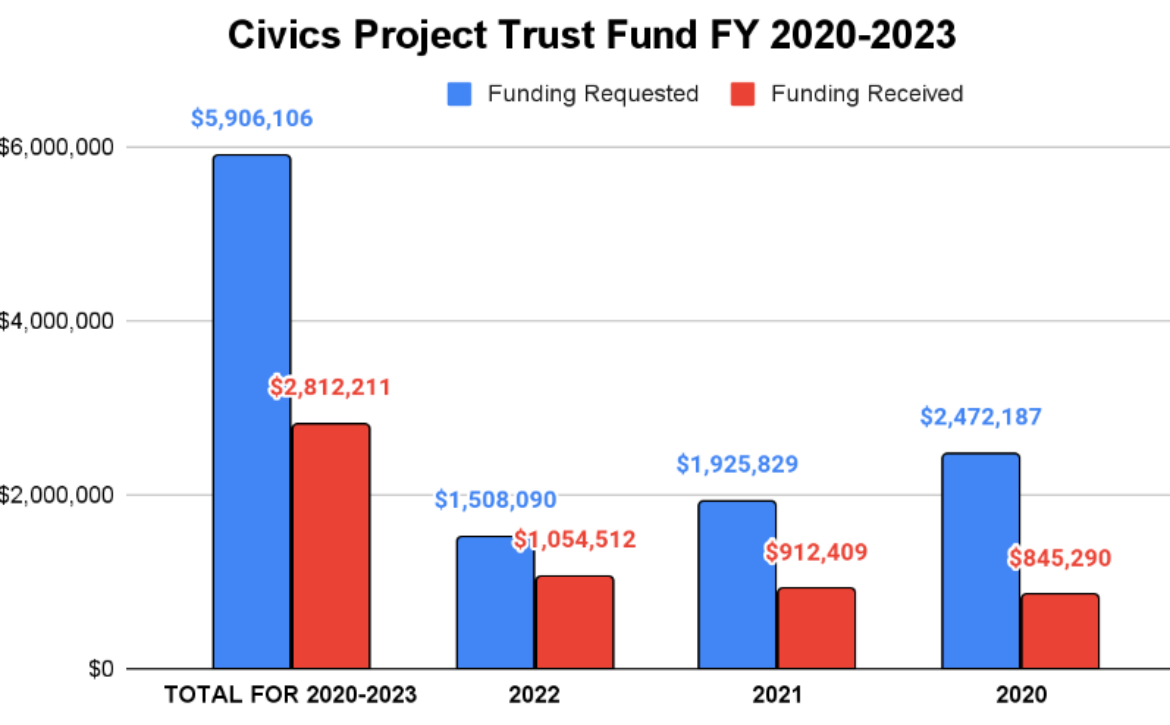
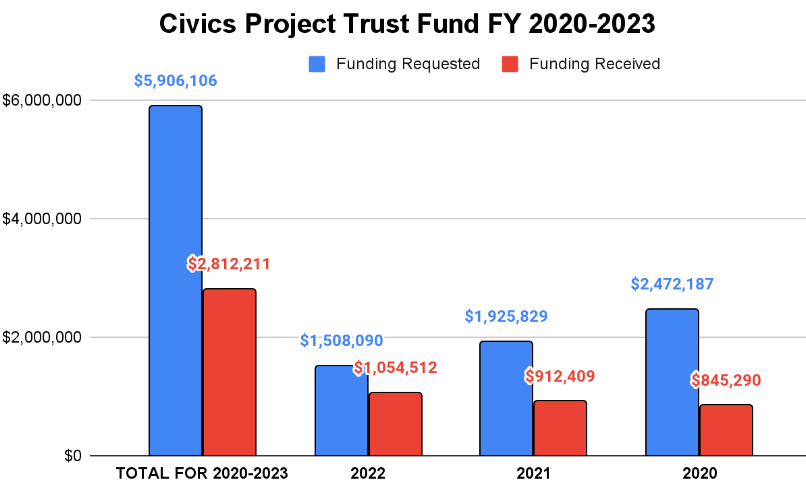
At the event, the Massachusetts Civic Learning Coalition (MCLC) released data on three years of grantmaking from the Civics Project Trust Fund that showed that less than half of the proposals from local school districts were funded due to the Fund’s limited amount of money.

“The policy and financial investments we’ve made in civics education here in Massachusetts are yielding real, tangible results, and we should continue to increase those investments so it is available to all students,” said Senator Becca Rausch (D-Needham).

The speakers, which included teachers and students from Boston, Lynn and Lowell, urged the Legislature to increase funding the Civics Project Trust Fund by $500,000 to a $2,500,000 level. The Trust Fund is used by state education officials to develop civic education curriculum and professional development for teachers and is also granted out to school districts to develop local civic education capacity.

Alice Mwangi, a senior at Lowell High School, talks about her work in Lowell to address issues of hunger and homelessness through her civic education class.

Discovering Justice is a proud member of MCLC that was formed five years ago to help pass the Civics Law of 2018. Discovering Justice Executive Director Matt Wilson, the Advocacy Chair of MCLC, and Adam Harrington, Discovering Justice Fellow, coordinated the event.

“Civics should be part of our school curriculums nationwide, and I’m proud to have been a part of the movement that made this law in Massachusetts. Every student deserves to learn about and participate in civic life. Building on this movement is more important now than ever,” said Representative Andy Vargas (D-Haverhill.), who was instrumental in the Civics Law passage in 2018. 

Representative Andy Vargas (D-Haverhill) tells the State House audience about the need to increase the Commonwealth’s investment in civic education.

“Civic education and engagement are foundational to building the nation’s capacity to protect and steward our democracy,” said Matt Wilson, Executive Director of Discovering Justice. “America’s youth can play a key role, now and in the future, by engaging in our democratic process to build more equitable, healthy, and vibrant communities. Yet they need to be taught the skills and perspectives and given opportunities to engage.”

Legislators were joined by students and teachers who told their stories about the impact of their civic education classes.

“I can confidently say that I have been able to grow as a person through community service and civic education and that is why I believe more people should have access to civic education,” said Anthony Gonzalez, a Junior at the Radio and TV Broadcasting Program at Lynn Vocational Technical Institute. “After seeing the impact, I was able to help make, and my growth being acknowledged by myself and my peers, I believe that every student in the Commonwealth should be able to experience those same things.”

“Civic education programs benefit the future leaders of our society, like my 6th grade student Eslenny Rosa who is here today. We have many students at the Mildred and throughout the Commonwealth who already excel academically, and civics allows us to pair those great academic skills with the kind of moral compass we want our future leaders to have,” said Derek Doherty, a 6th grade teacher for Boston Public Schools at the Mildred Avenue K-8 School in Mattapan.

“When I began to teach civics in my classroom, an amazing thing happened. Students were engaged in their community and truly involved in trying to solve issues in their neighborhoods,” said Joseph Jussaume, a history teacher at Lowell High School. “Students saw themselves, maybe for the first time, as part of the larger community picture. That they, even as young people, could bring about change.”

The Massachusetts House of Representatives will release its budget in the second week of April and the Senate will release their proposal in the middle of May. Governor Healey is expected to sign the budget for the new fiscal year by July 1.

Read More

New Partnership with the U.S. First Circuit Court

Discovering Justice’s close partnerships with legal professionals has provided the organization with the capacity and resources to provide top-notch civic education programming to students across the Commonwealth.

Last month, Discovering Justice and the U.S. First Circuit Court agreed to a new and innovative partnership to bring new civic education programs to students in Massachusetts.

“We are excited about our new partnership with the United States Court of Appeals for the First Circuit. Over the past year, the Circuit Court has prioritized civic education as a core component of its work,” said Matt Wilson, Discovering Justice’s Executive Director. “The partnership will bring new energy and perspectives to students across the Commonwealth.”

A significant initiative of the Circuit Court is the development and implementation of a Learning Center at the Moakley Courthouse. The Learning Center will provide educational engagement for a wide audience from students to teachers on their role and that of the courts in our democracy. The Learning Center at the Moakley Courthouse is anticipated to open formally in the fall of 2024.

The First Circuit and Discovering Justice will partner in programming the Learning Center, meeting with students on Field Trips, promoting Courthouse Events, and supporting the Mock Trial and Mock Appeal Programs. Discovering Justice will continue its long partnership with the District Court of Massachusetts which has been a vital partner since the organization’s inception.

Read More
Alexandra

Alexandra vonBallmoos

Alex has over fifteen years of administrative experience, most recently at Boston Schools Fund. Prior to her time at BSF, she served as an Executive Assistant to the Head of School at Mother Caroline Academy, where she also provided major support to the Development office. Before her time at MCA, Alex served as an assistant at a media firm in Washington, DC.

This role oversees financial operations such as reconciliations, expense tracking, payroll, and donor acknowledgments, while managing organizational systems, employee records, and meeting coordination. It also provides event logistics, Board support, and office management, ensuring efficient processes, accurate recordkeeping, and the successful execution of programs, operations, and special events like the annual Spring Gala.

Rana Suh Kannan

Rana Suh Kannan

Rana Suh Kannan has spent nearly her entire 20+ year career dedicated to providing students with access to high-quality education experiences that lead to strong academic outcomes. She brings extensive and diverse experiences as a teacher, school administrator, funder, and nonprofit professional. Rana is committed to Discovering Justice’s mission to enable students to become well-equipped with the knowledge, skills, and desire to build and sustain an equitable democracy.

Prior to Discovering Justice, Rana spent seven years at Boston Schools Fund, most recently as the Chief Operating Officer. She co-led the development of the organization’s second fund, and ensured its operationalization across the organization. Previously, Rana played pivotal roles at organizations such as Salsify, Phoenix Charter Academy, The Achievement Network, and Roxbury Prep Charter School. Rana graduated from Williams College with a Bachelor of Arts degree in History and Psychology. She earned her Master’s in Education Policy & Management from the Harvard Graduate School of Education.

Mehana Koch

Mehana Koch is a recent graduate of Wellesley College, where she earned a BA in Psychology. She joined Discovering Justice excited to learn about nonprofit operations and support an organization whose mission uplifts and empowers future engaged citizens.

At Discovering Justice, Mehana enjoys supporting both the administrative and fundraising needs of the organization. Her day-to-day work includes processing donations, reconciling accounting information, and maintaining a strong database. She also has played a large role in onboarding new staff and supporting large organization-wide events, such as the Annual Gala.

Bianca Lora

Bianca Lora is passionate about expanding access to civic education, uplifting historically underrepresented voices, and creating spaces where young people can grow as informed and active members of their communities. With a background spanning across organizing, policy, and fundraising, she brings a collaborative spirit to the work.

Prior to this role, she led cross-departmental initiatives for donors at the ACLU of Massachusetts, including its 800-person annual gala. Bianca has also served as a Senior Legislative Assistant for a Councilmember At-Large in Montgomery County, Maryland where she oversaw a legislative portfolio on government operations, economic development, public safety and social justice issues. She also launched an organizing campaign alongside the adjunct faculty at Prince George’s Community College with SEIU.